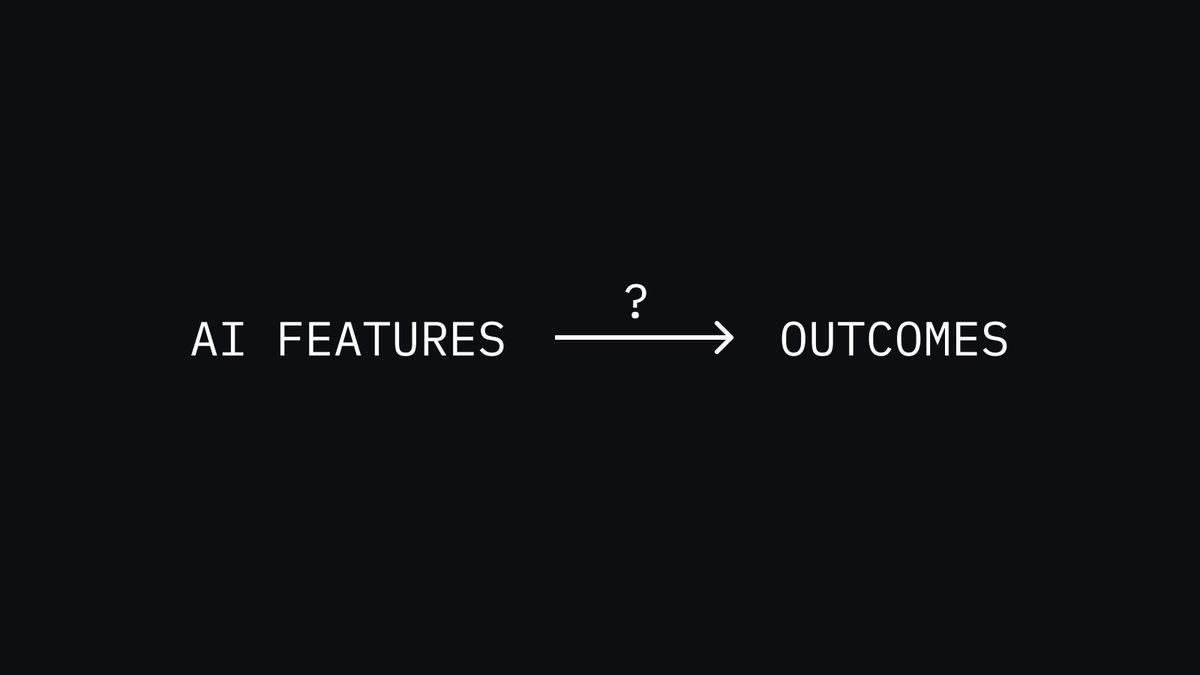
The big question every AI founder and product leader (at some point) asks themselves is, “OK, I’m building an AI product, I’m making a difference with my work, but how do I know which features generate revenue?”
Some AI builders don’t want to think about this question. They are impatient and want to get started with building, shipping, and executing. They’d rather try out a lot of different features and hope that some of those will eventually stick. Other AI builders are analytical and want to think before they act. They’d spend a lot of time on planning and debating while trying to figure out what their customers may or may not want.
Both are unfortunate strategies.
The question of how to know which features generate revenue requires you address two deeper questions, first.
The two most important product questions: What is the outcome I want to create? How do I link the outcome to revenue?
Now let’s define the word outcome before we move on.
An outcome is a measurable change in customer behavior caused by a product feature. It shifts focus from delivering an output (“add a chatbot”) to solving a problem (“customers find answers without contacting support”). You measure outcomes through adoption, retention, or closed support tickets.
Understanding how to change customer behavior makes your product much more likely to create value for the user. That value is what customers pay for.
So why do so many AI product teams still build around features?
- First, many AI founders were trained as engineers or researchers. They think in capabilities and features, not user outcomes.
- Second, features are easy. They’re the one language product, engineering, research, sales, and exec all share.
- Third, AI code tools have made feature output nearly infinite. Any team can now ship in weeks what took quarters. The question shifted from “can we build it?” to almost absurdly “how much and how fast can we build?”
While all of these sound like good reasons to keep building around features, they all prevent you from the benefits that outcome thinking delivers.
Outcome thinking forces you to put yourself in the shoes of your customer. It reduces the risk of building something nobody wants. You frame ideation and solution exploration around customer problems. This means that you’re less likely to jump preemptively to solutions and make more room for proper discovery. And most importantly, you connect every product investment to outcomes customers pay to achieve.
The shift to outcome thinking is a hard leadership decision.
Why doesn’t outcome thinking happen automatically?
Because feature delivery protects everyone in the org from accountability. Here are the mistakes that keep it that way.
- AI product teams build their roadmap from feature requests that come from customers, the sales organization, and the executives. Of course no one thinks in terms of behavior changes.
- PMs don’t know how to define an outcome or connect it to a feature. Leaders don’t have the time to train or empower them.
- Venture capital firms and boards ask about roadmap progress and features shipped. They’re not necessarily trained in outcome thinking.
This seems to work for everyone involved. Until it doesn’t.
And I believe the reasons are quite clear here. A feature seems tangible, but deludes everyone into thinking they understand what it really stands for. Outcomes on the other hand require explanation and therefore create friction. Sometimes, they’re hard to define and to measure (especially if the telemetry is not there yet).
So unless you move to outcomes, there’s a chance you stay stuck in shipping features but not knowing which ones move the business. Essentially, you’re unable to connect product investments to commercial results. And when growth stalls, the board doesn’t ask about your roadmap and all the reasons why it didn’t work out as planned. They ask about you.
Step 1: Establish outcome accountability as the operating standard
A team optimizing for feature delivery will always find a way to succeed, even when nothing moves.
This is why outcome accountability is so important. It means the team is responsible for whether the product changed user behavior, not for whether features shipped on time. This probably sounds simple.
So why don’t more leaders do it?
Because they wait for buy-in before setting the standard.
Declare outcome accountability as the operating standard for the product function. Change the executive review format and discuss the following artifact:
- outcome name,
- behavior baseline,
- target behavior,
- current metric. When sales or executives push back on losing feature commitments, there’s a simple way to still show features. More on that in Step 4, but in summary it’s possible to map outcomes to features.
Under output accountability, the team can always claim progress as long as something ships. Outcome accountability requires evidence of behavior change. That’s the distinction.
And it’s what lets you connect product investment to commercial results.
Step 2: Define outputs, outcomes, and impact for the org
Output, outcome, and impact are three different terms, so let’s clarify each one.
- Output: the feature or capability the team ships.
- Outcome: the change in user behavior the feature is designed to create.
- Impact: the business result that follows from the behavior change. Specifically, whether that change is one customers pay to achieve.
Introduce these terms inside product. Just don’t expect sales or finance to adopt them. They won’t. So your job as a leader is to translate this to everyone else (even if you hate doing it).
The product leader enforces this vocabulary inside product, for instance during roadmap reviews, planning sessions, and PM conversations. And cross-functionally? You translate. Sales speaks in features. You map those features to outcomes internally.
Run this diagnostic: have every PM fill in three fields for one initiative they own:
- output (what we’re shipping),
- outcome (what behavior change this creates),
- impact (what business metric that moves).
And when a PM presents a vague outcome, ask one question to help clarify: “What will users do differently?”
If you work on AI products, you need to pay extra attention. You may have a problem with outputs, because AI capabilities are described in technical terms by default. Your PM describes what the model does or is capable of. That’s different from what it does for the user.
Measurable outcomes are the only kind that matter.
Step 3: Map the customer journey as a sequence of outcomes
Can you name the moment in your product where a customer first gets real value, and what they had to do to get there?
The customer journey is a sequence of outcomes users need to achieve to get value from the product.
Each stage represents a behavior change the product is designed to enable.
Can you infer the customer journey from your feature list?
I’d argue that every team wants to answer yes. They know the features they’ve built. So they assume the journey follows. But it doesn’t work that way, since features are things you build. And the journey is what customers actually do.
Map the journey:
- Map each stage from first use to full value.
- Filter by commercial value (which stages do customers pay to solve?).
- For each stage, define the outcome.
Validate and prioritize:
- Validate the journey with direct customer contact.
- Map existing features to journey stages.
- Park features that map to nothing.
- For stages with no features, generate hypotheses and test before scheduling.
When the journey map is done, the product leader may realize how much of the backlog maps to stages customers skip entirely. That realization is the point. The journey provides the organizing structure for every product decision that follows.
Gaps become visible: stages the product should address but has no features for.
Step 4: Build the outcome-based roadmap
Once you mapped the customer journey as a sequence of outcomes, the next step is to build the outcome-based roadmap.
The outcome-based roadmap puts the desired outcome for the product and business front and center. It’s a very flexible tool, as it provides the “why” to the teams that are ideally empowered to discover the best solution. The flexibility is a great strength, but often gets read as “the team doesn’t know what they’re building yet.” Which is exactly the point.
When building your first outcome-based roadmap, it’s tempting to take your previous feature roadmap and add outcome labels to it. Don’t do this.
Instead, reverse engineer the problem to solve from the features you identified so far. Each roadmap item contains three things: the outcome, the user journey stage it belongs to, and a now/next/later commitment. No delivery dates. No numbered priorities.
One warning before you run this change: when sales asks for a feature commitment, your answer is the outcome that feature serves. That only works if your CEO backs the standard. Without that cover, sales will go around you. So translate the outcome roadmap into a tentative feature-based one for them.
It’s extra work, but usually worth it.
Why bother with all this?
The outcome-based roadmap is a transformation tool, as it shifts everyone’s focus from “what are we building” to “what moves the business needle.” And that shift is what makes discovery possible. When the team knows the outcome but not the solution, they have to explore, test, and learn.
This is the foundation for a culture of continuous learning and innovation.
Step 5: Define the outcome metric for every roadmap item
The last step is to identify the right metric for each outcome you want to achieve.
The outcome metric is the measurement that proves that the behavior change happened.
You need to define it before you start with discovery and development. This is often the moment when you realize that you need to invest in your instrumentation and monitoring capabilities to understand what is going on. It’s quite common to use multiple instrumentation tools because of the different types of things you need to measure. AI products generate rich telemetry by default. Tokens, API calls, sessions tell you what the model did, but not what value the user extracted.
Once you have a clear outcome definition and instrumentation in place, you’re ready to work in a more hypothesis driven manner. You’ll be able to associate your product development with user behavior and clearly answer: Did the user use this feature more often? And if so, by how much?
You can also see how much easier it will become to justify product investments. As you’re able to quantify the behavior change and relate that with the business impact, you provide the proof that the outcome moved.
Quantified outcomes close the argument with sales, with exec, and with the board.
That’s it.
Chat soon, Hayder